
This article was written and edited alongside my partner, Sarka. If you’re a Czech traveler or know the language, have a look at her Czech version of this article on the sharkadventurin blog.
Until recently, Albania wasn’t on many vacationers’ radar. However, as popular Mediterranean countries like Croatia and Italy grow pricier and become more overcrowded, this beautiful country has started to see an uptick in notoriety.
And, the attention is well deserved!
Sitting at the confluence of the Adriatic and Ionian seas, Albania packs a huge punch for a small country and offers a more budget-friendly way to see Europe. It’s also keen to show that its troubled history is long gone, while simultaneously emerging as one of the Balkans’ best holiday destinations.
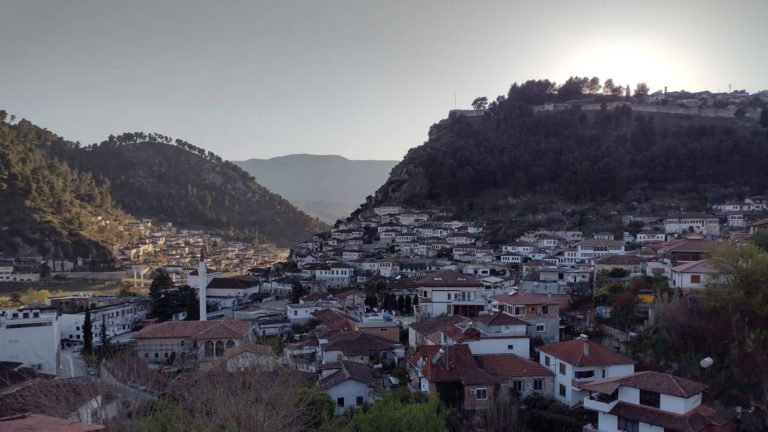
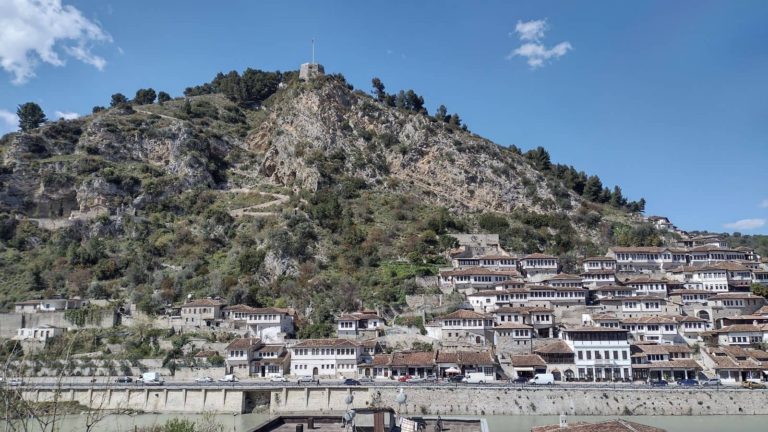
With splendid nature, ancient ruins, gorgeous beaches, and fairytale-like old towns, Albania offers something for history buffs, beach lovers, and hiking enthusiasts alike.
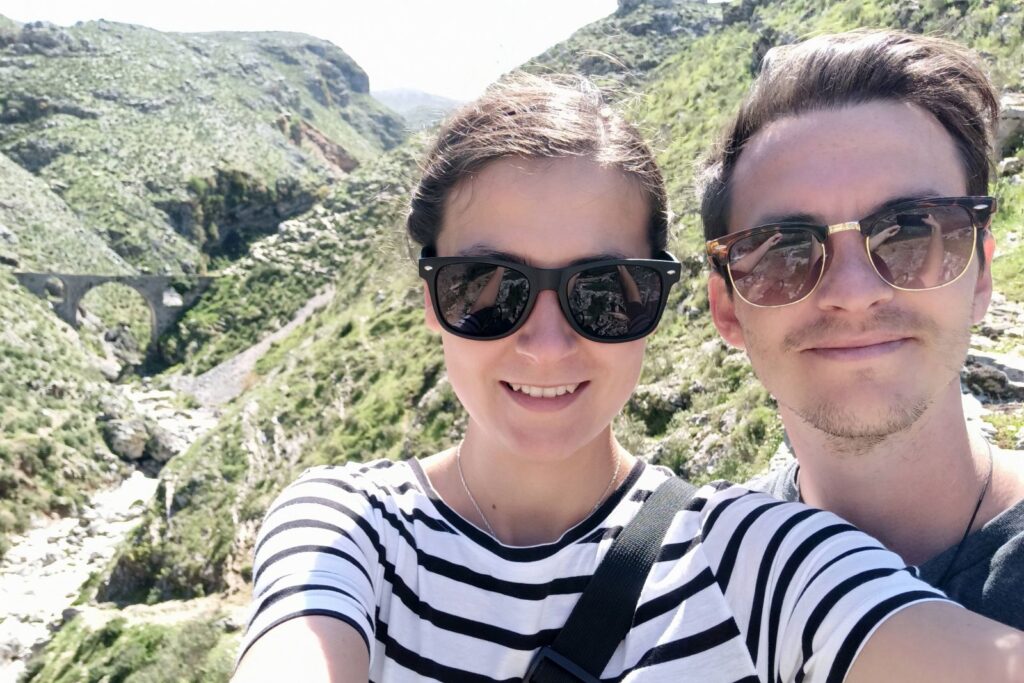
We had an amazing time traveling around the “Land of the Majestic Eagle” a few years back. There were some bumps and hurdles to overcome along the way, but in the end, we grew accustomed to “the Albanian way.”
This article covers all the things you need to know before visiting Albania. It’s an accumulation of everything we learned on our excursion, which we turned into a sort of first-timer’s guide to the country. It includes all the Albania travel tips you need for a fun and enjoyable trip, so the only things catching you off-guard will be the jaw-dropping scenery and warm hospitality.
If you’re interested in places to visit in Albania, check out my ‘Albania Travel Guide | The Best Places to Visit’ article.
The Best Time To Visit Albania
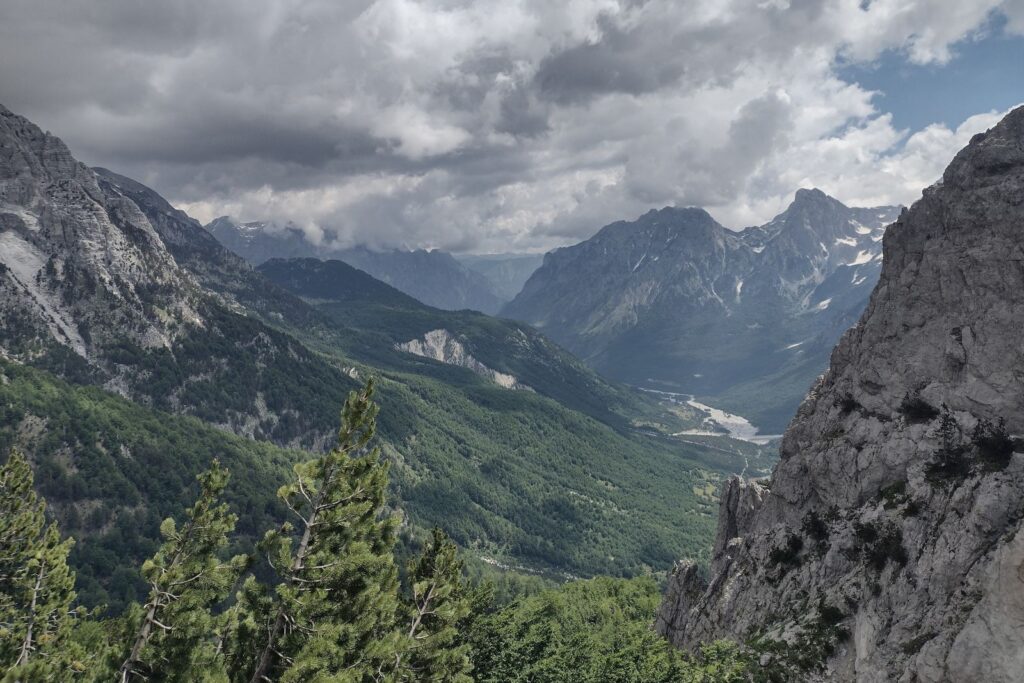
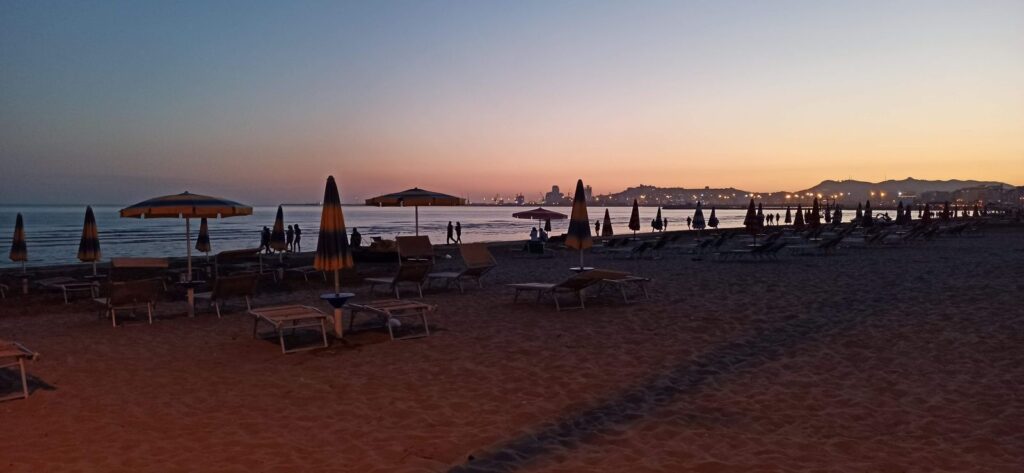
The high season in Albania is during the peak European summer holidays in July and August. The weather at this time of year is ideal for a relaxing break on the Albanian Riviera, as well as exploring the wild Albanian Alps.
Daytime temperatures on the coast hover around 34°C (93ºF), while the mountains stay at a comfortable 25°C (77ºF) on average. The risk of rainfall is very low during these months.
Unfortunately, with great weather comes huge crowds. Expect visitors en masse at the most popular spots, as kids are out of school and families have planned their holiday around that.
These are also the worst conditions for walking around historical towns, ancient monuments, and castles, where the narrow stone streets amplify the heat. For example, the charming UNESCO town of Gjirokaster is known for turning into a giant furnace during the summer. Although sunset walks, or xhiro as their called in Albania, are at their best.
The winter is mild and rainy in most of Albania. However, while it isn’t exactly known for its winter sports, there are some great options for adventurous backcountry skiing or snowboarding. There are also a few small but well-equipped ski resorts. You can check out Natyral Razma and Boga in the north, or Ski-Pista Bigëll and Voskopoja near Korçë.
Overall, though, the best time to visit Albania is during the off-season.
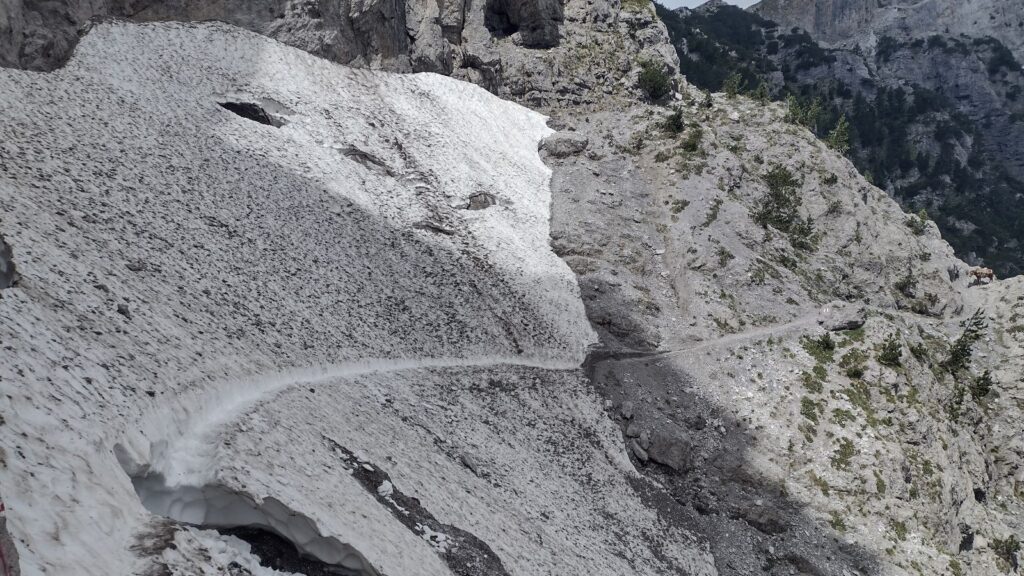
That means the end of April, all of May, June, September, and the beginning of October. The days are pleasant, as is the sea. There aren’t too many tourists around, and you’ll be able to enjoy the sights without working up too much of a sweat. Just note that the famous Theth–Valbona hike may remain closed as late as May. It even had a snow slide as late as June when we were there.
The second-best option is to divide your exploration of Albania into two trips. Enjoy the beaches and mountains during the height of summer, and dedicate another spring or autumn visit to the fascinating history, culture, and architecture.
Entry Requirements
Albania is visa-free for tourists of many nationalities, including the US, UK, EU, Canada, Australia, and New Zealand. However, not everyone gets the same amount of time.
Here’s a quick overview, but like always, check your government’s and Albania’s official travel website before booking your trip.
US Passport Holders
U.S. citizens have the option to stay for up to 365 days.
If you’re planning to live in Albania for over 90 days, though, you need to register at your local police station within 8 days of arrival. Also, don’t forget that if you work as a digital nomad, you will be considered a tax resident after 183 days. If this is the case, you’ll want to apply for a Type D visa.
No matter what, though, your passport must be valid for at least 3 months from the date of arrival.
Other Passport Holders
Citizens of the EU, UK, Australia, Canada, New Zealand, Japan, South Korea, and Israel get 90 days within a 180-day period.
The period counts back from each day of your stay, meaning it moves forward every day. Your passport must be valid for a minimum of 3 months beyond your planned exit from Albania. You can use this handy calculator for help. It says Schengen Visa calculator, but the same rules apply as the Albania Visa.
Citizens of other countries may need to apply for an e-visa through this website. It also serves those planning to stay longer than the visa-free period, or for reasons other than visiting, business, and short-term study under 90 days.
Is Albania Safe?
Many foreigners still worry about the safety situation in Albania because the country has had a poor reputation for decades. It was caused by its complete isolation during the rule of communist dictator Enver Hoxha, and the chaos after his death in 1985.
The country’s transition to democracy didn’t go so smoothly, as corruption and crime reached massive proportions. Some Albanian underground groups also gained notoriety abroad, giving their homeland a bad name.
This is all in the past, though.
Nowadays, Albania is considered a safe country. You don’t have to take my word for it; check out this website that ranks countries based on their safety scores.
Unless you’re involved in some shady business or local politics, you have nothing to fear. Even hitchhiking is extremely easy thanks to the kindness and hospitality of locals.
Of course, you should not ignore the fact that this is still one of the poorest countries in Europe, so for less experienced travelers, it’s better to stick to the typical areas. In short, use common sense, watch for the usual tourist scams such as overcharging, and keep an eye on your belongings as you would anywhere else.
A NOTE ON WILDLIFE
Even though there are wolves, lynx, and bears in the mountains, they mostly live in remote areas and don’t seek out human interaction. What you should beware of, however, are venomous snakes around dry, rocky slopes. There are several species around the Balkans, one of which is the nose-horned viper. It has a horn on its snout and a zig-zag pattern on its back, and has the most toxic venom of the bunch.
However, it’s not aggressive unless it feels threatened, and the bite is very rarely fatal when treated. Just be aware of your surroundings and watch your steps. Albanian nature is stunning, and you should definitely not miss out on it!
Clothing In Albania
You may be wondering about the dress code in Albania since, officially, around 50% of the population claims to be Muslim. In reality, only a small number of people consider religion an important part of their lives.
It’s rather a family tradition and a part of one’s identity. Not many practice actively, and veiled women are not a very common sight. Naturally, do wear modest clothing while visiting religious sites, but otherwise, bring a normal weather-appropriate wardrobe.
As with most European beach destinations, bikini-clad divas and male nipples (or hefty naked beer bellies) are not appreciated outside of the beach.
The Albanian Language
Albanian is an Indo-European language, but don’t expect to understand more than a few international words. It forms its own linguistic branch, meaning it’s not similar to its Slavic or Greek neighbors.
Still, communication as a tourist isn’t difficult. You can get by with English, some basic Italian, or simple body language. We met a lot of people, especially at farmers’ markets and in public transport, who didn’t know a word of English, and it wasn’t a problem because they’re friendly and willing to write the price down or show it in banknotes. Pantomime will do for the rest.
To stay on the safe side, you can download the Google Translate app with offline Albanian and English on your mobile phone. You’ll be able to use Google Lens translation with data or wi-fi, but honestly, we survived without it, and so you can too.
It also helps to download at least one offline map. We usually don’t leave much to chance and have Maps.me, Mapy.com, and Google Maps between the two of us. Each has its advantages.
If you’re interested in learning a bit of Albanian, I recommend the Ling app as the language is not available on the more popular, free Duolingo app.
SOME HANDY ALBANIAN PHRASES
Përshëndetje (per-shen-det-ye) | Hello – a respectful, all day greeting
Mirëdita (meer-dee-ta) | Good day – the most common greeting from late morning to early evening
Mirupafshim (meer-oo-paf-shim) | Goodbye – both formal and casual
Ciao! (cha-oh) | Hi/Bye – you’ll hear this Italian phrase a lot in areas with an Italian influence
Faleminderit (fa-le-min-der-it) | Thank you
Ju lutem (yoo loo-tem) | Please/You’re welcome
Më falni (muh fal-nee) | Excuse me/I’m sorry
Po / Jo (po/yo) | – Yes / No
Sa kushton? (sa koosh-ton) | – How much is it?
Transport In The Country
Renting a car is a popular way to explore Albania for those planning more than a resort holiday, but it’s not the only option.
Here’s a little more about car rentals, how to get from the airport, and navigating the chaotic yet effective bus system:
Good to know | Uber doesn’t work in Albania. Similar services are taxi.al, UPs, and Speed Taxi.
Airports In Albania
Tirana
The main international airport of Albania is Tirana International Airport Nënë Tereza (TIA), also known as Rinas. It’s located in Rinas village, about 17 km outside the capital.
It services flights from all around Europe and the Middle East. If you’re flying from the US, you’ll have at least one layover, even though Delta Air Lines is reportedly interested in launching a direct route in the future.
Here are the ways you can get to/from the Tirana airport:
Shuttle Bus | The cheapest and easiest way to get from Tirana airport to the city center is a LU-NA shpk shuttle bus. It waits by a bus sign at the parking lot right outside the exit from the arrivals hall. Don’t be alarmed if you only see a van — that’s how a lot of the buses in Albania look. Departures are 24/7, every hour, and the cost is 400 Lek. You can even buy a ticket online now, but it’s not for a specific time. The buses usually run when they’re full and provide a larger vehicle during peak times. The stop in Tirana is behind the National Opera and Ballet Theater, and the ride usually takes about 30 minutes.
Check out connections to other cities on the airport website.
Taxi | A taxi from the Tirana airport to the center costs around 2,200 Lek (€22). Drivers will fight for your attention the minute you exit the arrivals hall. The official provider recommended by the airport is Auto Holiday Albania. It runs yellow taxis with the airport logo on their side. You can book a ride to any major Albanian city ahead of time on their website.
Other Airports
Kukës International Airport Zayed | This airport, near the border with Kosovo, opened in 2021 but saw its last flight in 2023 due to a low interest from travelers and airlines alike. However, Prime Minister Edi Rama announced new plans for the airport earlier this year. A brand new carrier, Air Kosova, should start operations in the future, but it’s unlikely to be relevant to international travelers unless they’re interested in visiting Kosovo.
Vlora International Airport | A highly anticipated airport that will significantly shorten the travel time to the gorgeous Albanian Riviera. It was supposed to welcome its first travelers in Spring 2025, but the opening keeps getting delayed due to a string of corruption scandals. Until this Albanian dream comes true, you’ll have to settle for Tirana Airport or the airport on the popular Greek island of Corfu.
Corfu International Airport | Corfu International Airport (CFU) is well-connected to the ferry port by bus line 15, which also passes through Corfu Town. The bus stop is right outside Terminal A, and the ride should cost between €1.5 and €2. Taxi stands are located in the same area. There are multiple ferries to and from Sarandë every day during the high season. The two carriers, Finikas Lines and Ionian Seaways, operate various types of ferries and boats. Prices range between €20 and €30. The journey may take as little as 30 minutes, although car ferries take about 2.5 hours.
While searching for cheap flights, you can also have a look at Podgorica, Pristina, and Ohrid. It’s a short bus ride to Albania from all of these, and you’ll have the chance to see another interesting country.
The Bus System
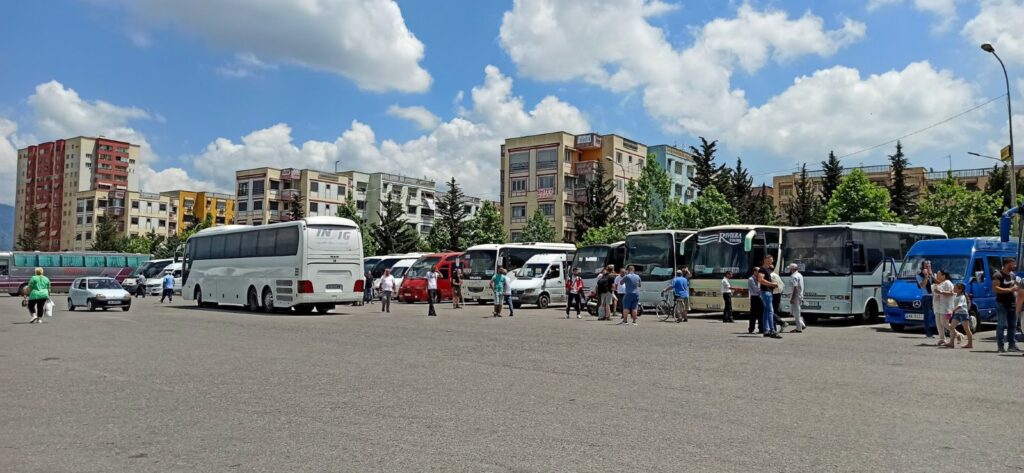
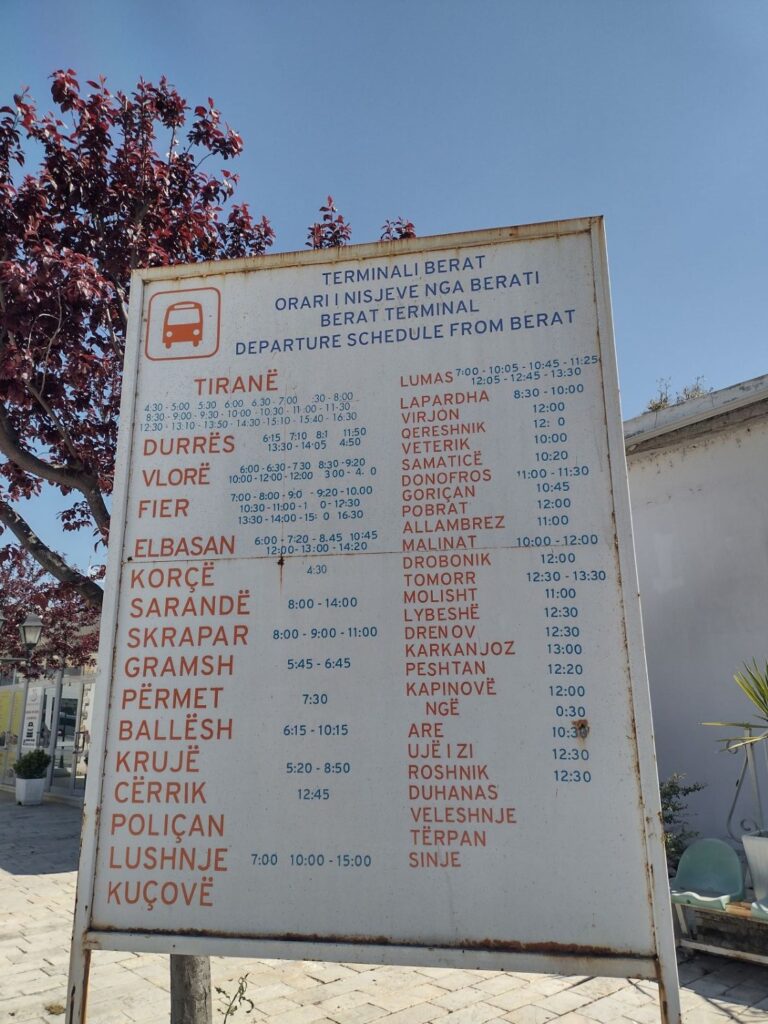
You can get almost anywhere in Albania by bus, coach, or a shared minibus/van called a furgon. Unfortunately, it’s a bit tricky to find up-to-date information online, and the furgon or bus stops aren’t always marked on Google maps or at all. Plus, schedules and stops are changing all the time as more visitors come to the country. But once you get used to some waiting and asking around, you’ll be unstoppable!
In 2024, the Albanian government introduced a new website and app, eTransport.al, aiming to make intercity travel easier. It’s not fully functional yet and doesn’t have all the options, but it’s worth checking out. While the route search doesn’t work well, the list of specific lines with timetables seems to be accurate. Some of the lines also show up on Google Maps, but don’t get discouraged if you don’t find anything. Chances are you can get where you want by a furgon that’s just not online. For now, the absolute best source of information remains the locals.
As we traveled around the most popular spots in Albania by bus before the website existed, we created a list of stops, stations, and some timetables based on our experience, with later updates by kind travelers.
You can find that article here: A Detailed Guide to Albania Buses | Timetables, Routes, and More
Driving in Albania
Renting a car in Albania is very popular, as it offers flexibility. It’s cost-effective for families, and since the country is relatively small, road trips become viable for short-term travelers. However, driving in Albania, or anywhere in the Balkans for that matter, requires some mental preparation.
The signs and laws seem to be more of a suggestion than a rule of law. Of course, if a foreigner were to make a mistake, the police would be right there demanding a fine or a bribe, so make sure to stick to the rules. Like everyone else, be on high alert, arm yourself with patience, and don’t skimp on insurance.
The price range of a car rental in Albania is huge, depending on when and how far ahead of time you’re looking. The average for 2025 was about €47 per day, and while local rental companies offer better deals than the international ones, it’s important to read the reviews and fine print. My go-to is Discover Cars, a comparison website similar to Booking.com. If you decide to use it, I recommend sticking to companies with an 8+ rating and reading the terms and conditions carefully.
To drive in Albania, you’ll need your regular driver’s license plus an International Driving Permit of the 1968 Vienna Convention type.
You may find articles stating that the EU licenses written in the Roman alphabet and UK licenses are okay by themselves for a short visit. These also say that the US and Canada are in a sort of grey zone, as in Abanian officers will likely not ask you for the IDP.
Still, if a police officer wants to find a reason to fine you or your insurance company wants to avoid a payout, a lack of IDP could be the deciding factor.
The Train System
The railway infrastructure in Albania is slowly being revived, but as with all ambitious development projects, it’s hindered by corruption. As long as the Tirana train station remains closed, there’s no practical use of the trains for tourists.
If you’re an enthusiast, you can check the lines and schedules here.
Staying Connected When Visiting Albania
Internet
You’ll have no problem staying connected in Albania. Good Wi-Fi is a standard in almost all accommodations except for some remote rural and mountain villages.
Heck, even the Grunas Waterfall near the mountain town of Theth has public wifi. The same goes for most restaurants and cafes. You just have to ask for the password; it is rarely displayed anywhere.
Phone
The Albania country code is +355, and the main emergency number is the European standard 112. In less acute situations, you can call the police (126), ambulance (127), or fire department (128) directly.
Best Albanian SIM
Albania is not a member of the Schengen Zone or the EU, so be mindful of high roaming charges. Personally, we didn’t need a SIM card for our three-month trip. We agreed on the approximate time of arrival with our accommodations in advance, used offline maps, and went to a cafe if we really needed to check the internet while out and about. Lots of Albanians use WhatsApp, so there’s no need for a local phone number during a short stay.
If you prefer to have data on the go, you can easily get a local SIM at the Tirana airport (more expensive) or at the many One and Vodafone kiosks and stores. One and Vodafone are the main providers; both offer the same tourist packages for the same price, with Vodafone reportedly having the better coverage.
The tourist packages currently start at 2,600 Lek (€27) for 40 GB of data across 21 days. You might also be able to get a cheaper 3 or 10-day prepaid SIM at the Vodafone store. According to the Vodafone website, all prepaid plans, including tourist ones, should be valid for the entire Western Balkans (Montenegro, Kosovo, North Macedonia, Serbia, Bosnia and Herzegovina).
A good alternative is an e-SIM, which you can conveniently install at home and activate on arrival. You just have to check your phone’s compatibility. Airalo in Albania starts at €4 for a 1GB package for 7 days. If it’s your first time and you use a discount code, you can get this e-SIM for €1!
Electrical Outlets
The most common electrical outlets in Albania are type C (Europlug) with two round pins and no grounding. You may also come across a type F plug with grounding clips on the side. The voltage is 230V, and the frequency is 50 Hz.
Accommodation
In our experience, Booking.com is the best place to find accommodation in Albania. Besides hotels and B&Bs, they also offer lots of private apartments at a better rate than Airbnb (except for Tirana in some cases).
Download the app and create an account, as both can get you considerable discounts. Since tourism started developing quite recently, you will come across some beautiful, new, family-owned apartments.
Those were our favorites because they were perfectly clean and the owners were incredibly nice. We got invited for coffee and homemade rakija on several occasions.
Finances
The official currency is the Albanian Lek (ALL), which is not commonly found in exchange offices abroad. But no worries, you can use euros for the bus from the airport, taxis, most accommodations, and in some restaurants and shops in the tourist areas. That convenience naturally comes at the cost of an unfavorable exchange rate. While card payments have become a little more common in the popular spots, it’s always good to have some cash on hand.
We prefer to get local currency directly from an ATM with a Wise or Revolut card. However, that has recently become quite costly in Albania when all the banks slapped on a €5 to €6 charge for each withdrawal in 2023. Unless you’re a lucky owner of an American Schwab debit card, which refunds all ATM fees, a money exchange is the better option. Exchange offices in Albania offer better rates than any bank. There are plenty of them, especially in Tirana, and I’ve not seen any complaints about their credibility.
A budget double room or an apartment during the summer costs about 2,000 to 4,800 Lek (€20 to €50) per night. A meal in a traditional restaurant for two, including house wine, comes up to about 2,000 Lek. And, a quintessential part of the Albanian café culture, an espresso, is approximately 80 to 100 Lek. Groceries are very affordable compared to the US and the UK.
Drinking Water
Despite the official government claim, the tap water is not safe to drink, especially in big cities.
It contains so much chlorine that foreigners often complain of stomach cramps after regular consumption, plus many buildings have problems with old piping.
You won’t see many locals drink it either; they prefer to buy bottled water for drinking. You’ll find anywhere from 4 to 8-liter (and smaller) bottles of drinking water available in any store for cheap. The tap water is, however, okay for brushing your teeth and cooking.
Eating Out
Dining at a restaurant might seem like a no-brainer, but there are a few tips worth knowing.
Compared to the US or the UK, Albanians don’t want to seem too eager when it comes to getting you out of their establishment. They rarely bring you the bill on their own, so prepare to play a funny little game of cat and mouse with the waiter before leaving.
First, you have to make eye contact with the staff, which they’ll avoid like Leonardo DiCaprio does with women his age. Then make the universal gesture of signing a check in the air to indicate that you want to pay. If they come before you do that, there’ll be another delay.
But it doesn’t end there. It’s not polite to stand and look at your wallet, so if you don’t have the money ready, they will walk away. Then the next round of eye contact tag begins. If you have the exact amount, you can leave it on the table and point it out when you leave.
The whole process may seem tiring, but I find it better than some places that obviously want you gone after your last bite. There is simply no rush in Albania, so sit back, relax, and enjoy some people watching.
Note | A tip is not required, but is appreciated. Ten percent, along with a compliment on the food, can get you a shot of rakija or a dessert on your next visit.
Conclusion
If you’ve read all the way through our Albania travel tips guide, I hope you have an amazing time in Albania!